Rhysand
A Court of Thorns and RosesRhysand’s decisive significance lies in the gap between the role he performs and the allegiance he ultimately claims. He appears as a beautiful, dangerous High Fae associated with Amarantha’s court, yet his own explanation of his conduct presents him as someone who refused to remain passive while Prythian suffered. The narrative makes him a figure of political ambiguity: apparently a servant of tyranny, he is also a survivor using the tyrant’s system against itself.
Identity and Introduction
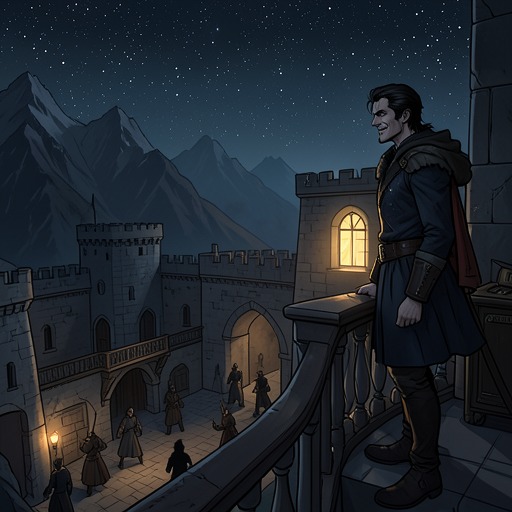
Rhysand is the High Lord of the Night Court. When he first appears to Feyre Archeron, he is unmistakably High Fae, with short black hair, pale skin, and blue eyes so deep that they appear violet in firelight. His physical grace is paired with an unnerving stillness; rather than reassuring Feyre, his composure makes her want to flee. He is also unmasked, marking him as a figure from another court and separating him visually from the masked inhabitants of the Spring Court.
His entrance establishes the central contradiction of his characterization. Rhysand’s beauty is described as almost heartbreaking, but the same scene gives his presence a feral and deadly quality. He approaches Tamlin with deliberate ease, dressed in rich clothing cloaked in tendrils of night, and addresses him with a familiarity that exposes their long history. His manner is neither openly deferential nor conventionally hostile. Even his slight inclination of the head is not a bow, making rank and resistance visible in a single gesture.
Political Position Under Amarantha
Rhysand’s position is shaped by the larger history of Prythian’s subjugation. The Treaty divided the former wartime world between the High Fae and faeries of the North and the mortals of the South, while the Wall was intended to keep the realms apart. Amarantha later exploited trust between the courts, secretly transported her forces through trade routes, stole the powers of the Seven High Lords, and seized Prythian. For forty-nine years, the courts remained under her control while she gathered dangerous allies and prepared for a possible assault on the human territories.
Within this order, Rhysand is publicly branded as Amarantha’s whore. Lucien Vanserra uses the insult to reduce him to a collaborator, and Rhysand answers that he may indeed be her whore, but not without reasons. His response does not deny the appearance of submission. Instead, it makes the appearance itself part of the mystery. He contrasts his present role with the older image of Tamlin as a brutal war-band leader, accusing Tamlin of retreating among hedges and flowers while the world has gone to ruin. The exchange presents Rhysand as someone who condemns resignation even while inhabiting a compromised position.
His conduct also reflects the legal and political disorder created by Amarantha. The Treaty once established a clear principle: an unprovoked human attack on faerie-kind required a human life in exchange. Under Amarantha, however, law becomes personal decree. She determines who may cross the Wall, who may be punished, and when prisoners will be released. Rhysand’s survival therefore depends not on a stable legal order but on navigating a regime in which power, punishment, and apparent loyalty are controlled by one ruler.
Methods, Bargains, and Coercive Power
Rhysand’s most direct weapon is mental domination. During an execution before Amarantha, he stands behind a terrified Summer faerie and uses his talons to enter the male’s mind. He then reports that the prisoner intended to escape to the Spring Court, cross the Wall, and flee into human territory. The scene leaves open the precise choice Rhysand made while searching the mind: the Summer High Lord’s relief suggests that Rhysand may have suppressed or shaped what was revealed rather than simply exposing every thought. His power is therefore both terrifying and politically useful, allowing him to control information in a court where truth can mean death.
His bargain with Feyre demonstrates the same mixture of precision and coercion. After Feyre’s arm has been damaged by poisoned magic, Rhysand offers to heal it in exchange for her presence at the Night Court for two weeks every month, during two weeks of his choosing. The arrangement is to begin after Amarantha’s three trials. Feyre immediately refuses, recognizing that she has already entered one dangerous bargain, but Rhysand treats the refusal as an opening for further pressure. The bargain binds his assistance to future access to Feyre, making his generosity inseparable from control.
The bargain also confirms that Rhysand operates through the same contractual logic that governs much of the faerie world. Deals are not casual promises; they turn desire, injury, and survival into enforceable obligations. Rhysand’s offer is especially revealing because it is not presented as simple rescue. He heals Feyre, but the healing creates a continuing relationship and places part of her future under his authority. His actions resist Amarantha’s power while reproducing the coercive structure through which faerie power is exercised.
Relationship to Amarantha and the Resistance
Rhysand’s relationship with Amarantha is defined by proximity without surrender. She has made Prythian her possession, welcomed the most vicious creatures into her sanctuary, and used the conquered courts as the foundation for a future military assault on human lands. Rhysand’s access to her court gives him a vantage point from which he can survive, observe, and act, but it also makes him appear complicit in the oppression he endures.
His resistance is not romanticized as open heroism. When Feyre is tortured after Amarantha refuses to honor the immediate freedom that Feyre believes she has won, Rhysand is among those who reacts. His voice roars her name while Amarantha repeatedly breaks her body and restores her consciousness so that the pain will continue. The cry does not free Feyre, and it does not stop Amarantha, but it exposes a break in the mask of indifference Rhysand has maintained before the court. His apparent helplessness is part of the tragedy of his position: he can wield terrifying power, yet he cannot simply overturn Amarantha’s authority in the moment of Feyre’s punishment.
Amarantha’s response to Feyre’s victory reveals the regime’s final abuse of interpretation. Feyre has solved the riddle and fulfilled the trials, but Amarantha claims that she never specified when the prisoners had to be released. The ruler turns a promise into an instrument of delay, demonstrating how completely her personal will has swallowed the law. Rhysand’s reaction to Feyre’s suffering occurs within that broken system, where protest can be registered as feeling but not yet converted into effective action.
Change, Revelation, and Ending
After Amarantha’s defeat, Rhysand’s character is reinterpreted through his own account of why he fought. Feyre remembers the blood on his nose and the pain visible in his violet eyes, then asks why he took part when he could not do anything useful. Rhysand explains that he did not want future legends to remember him as someone who stood on the sidelines. He wanted his future offspring to know that he had been present and had fought against Amarantha at the end, even when his actions could not change the immediate outcome.
This explanation recasts his earlier behavior without erasing its menace. The beautiful stranger, the taunting rival of Tamlin, the self-described servant of Amarantha, the mind-reader at an execution, and the bargainer who claims a portion of Feyre’s future all become aspects of one survival strategy. Rhysand’s resistance is deliberately indirect because the direct alternative is submission or destruction. His ending position is therefore not that of an uncomplicated savior but of a politically intelligent survivor whose choices remain morally abrasive even after their purpose becomes clearer.
Narrative Role and Significance
Rhysand functions as a withholding and destabilizing presence in Feyre’s first-person narrative. Feyre sees his beauty before she understands his motives, hears his dangerous banter before she knows what his public allegiance conceals, and experiences his power primarily as threat. Because her knowledge is limited, every gesture carries two possible meanings: cruelty may be performance, and assistance may be another form of possession. This restricted perspective makes Rhysand’s eventual explanation a retrospective reordering of earlier scenes rather than a simple introduction of new information.
His significance also lies in the contrast between visible sovereignty and hidden agency. Amarantha rules through conquest, stolen magic, sanctuary for monsters, and arbitrary interpretation of promises. Rhysand cannot overthrow that structure immediately, so he works within its corridors, accepting disgrace in order to retain a chance to act. The result is a character whose central motif is the mask—not merely a physical object associated with court identity, but a political persona worn before an audience that would punish open dissent. When he finally explains that he chose not to stand aside, the narrative does not make the mask disappear; it shows why he needed one.